Author: Mark Rouse
Introduction: Why Pricing matters on Zalando
Zalando is a fashion marketplace where search relevance, pricing and customer behaviour in combination determine whether a product gets seen, clicked, and ultimately bought. Why does price matter? A well-chosen price influences:
- Search and browsing ranking
- Conversion rates
- Value Perception (compared to competitors)
- Campaign eligibility (Sales and Promotions)
Pricing isn’t neutral — it’s a ranking signal for Zalando’s algorithm and this is critical for achieving Page 1 placement!
According to Zalando’s own documentation, relevance is the primary ranking factor, but price, promotions and stock availability also influence what buyers see first in search or category browsing.
In this paper you will find information on how to ensure your pricing strategy optimises the ranking of your products on Zalando.
How is Price relevant in Zalando’s Ranking System?
While Zalando doesn’t publicly reveal its full ranking algorithm, key signals include:
- Search relevance: If your product keywords match the search query, it enters the candidate pool. Use your SEO process to find the best keywords.
- Price and promotions: Competitive and psychological price points can boost relative ranking position. Promotional activities will also help (be aware that Zalando does not currently use multi-buy promotions).
- Popularity and conversion signals: Products that sell more and/or have a better conversion rate tend to rise.
- Stock and availability: Items in stock and ready to ship are prioritized. The algorithm also considers the level of returns.
- Sponsored content: Merchandising and sponsored listings get visible premium placement.
Meaning, your product’s price relative to competitors — both internal (other Zalando listings) and external (other channels) — has a direct impact on whether customers discover it on Page 1 or not.
Pricing Signals that influence Page 1 Ranking
A product’s price affects its ranking through several mechanisms:
- Price Thresholds and Psychological Price Points
Certain price levels attract more demand. On Zalando, buyers often filter by price brackets, e.g., €0–50, €50–100, €100–200. Hitting the sweet spot in popular brackets increases impressions. There are certain price points that have retained their psychological importance eg. €49 or €49,99; these have the double benefit of sweet spot plus the illusion of paying significantly less. So €49,99 is exactly 1 cent less than €50 but seems distinctly cheaper. The specific psychological price points vary by product category, but all follow the same logic. Align your prices accordingly!
- Sales and Markdown Signals
Discounted prices signal value and are often highlighted in Zalando’s browse and search UI (e.g., “Now €59,99, was €79,99”), which boosts CTR (click-through rates) — one of the strongest implicit ranking signals.
Zalando enables sellers to include promotional prices with original and sale prices in feeds. Markdowns are attractive for the algorithm because they improve CTR and conversions. Products in official Sale categories receive additional visibility in site navigation and campaigns.
Remember also that there are psychological markdown percentages in the same way as psychological prices. The most relevant of these are 25%, 33% and 50%. Beware of very high percentages however: these are only signalling to customers that the product is unwanted!
Pricing Dynamics for Multi-Seller Brands vs Own Brands
Multi-Seller Brands
These are brands with multiple sellers offering the same product on Zalando. Many major brands, such as Nike, Levi’s, or Tommy Hilfiger, fall into this category.
Key challenges:
- Price competition between sellers
- Risk of progressive discounting where sellers undercut each other
- Market price volatility
- Compliance with EU anti-competitive pricing legislation
Here’s how pricing affects the product ranking:
- Price convergence increases visibility: When several sellers price within a tight band, Zalando’s system sees the product as competitive and often pushes it higher in search because it’s “fair” to customers.
- Exceptions can get penalized: If one seller is much higher or much lower than the median price across marketplaces, the algorithm can downgrade that listing or suppress it to avoid customer confusion. Zalando, like other marketplaces, factors median prices into decisions to prevent extreme prices (higher or lower) dominating results.
- Price parity rules: Zalando enforces rules around fair pricing. If a product is priced significantly higher than on other channels or brands’ own online stores, it can hurt its visibility or even lead to it being blocked. This prevents artificially inflated prices and unreal product discounts.
Example: If multiple authorized sellers list a product at €50 – €55 but one seller lists at €65 without marketing justification, the higher one is less likely to be shown prominently.
Opportunity: If all sellers operate within a narrow band, the product often appears on Page 1 of search results for that product because the platform sees it as competitive and relevant.
Beware: Under EU legislation, any attempt to manipulate product prices together with a competitor is illegal and can incur significant financial sanctions!
Own Brands and Exclusive Products
Zalando increasingly promotes its own brands (e.g., Zalando Essentials, Zalando Sport, Zalando Selection) and exclusive collaborations.
These differ from multi-seller brands because:
- Zalando controls price strategy.
- There’s no internal competition on the same SKU.
- Zalando can decide promotions and spotlight placements.
Pricing advantages for own brands and exclusives:
- Zalando (and the brand for exclusives) can set optimal price points to maximize both search ranking and margin without outside sellers undermining them.
- Sales and markdown strategy is centrally controlled.
- Zalando’s merchandising teams may give preferential placement to these products, especially when tied to platform-wide campaigns.
Example: Zalando Essentials T-shirt priced at €19,99 may rank above a comparable generic brand’s €19,99 T-shirt because Zalando’s system recognizes internal promotions and consumer search patterns favouring value offers.
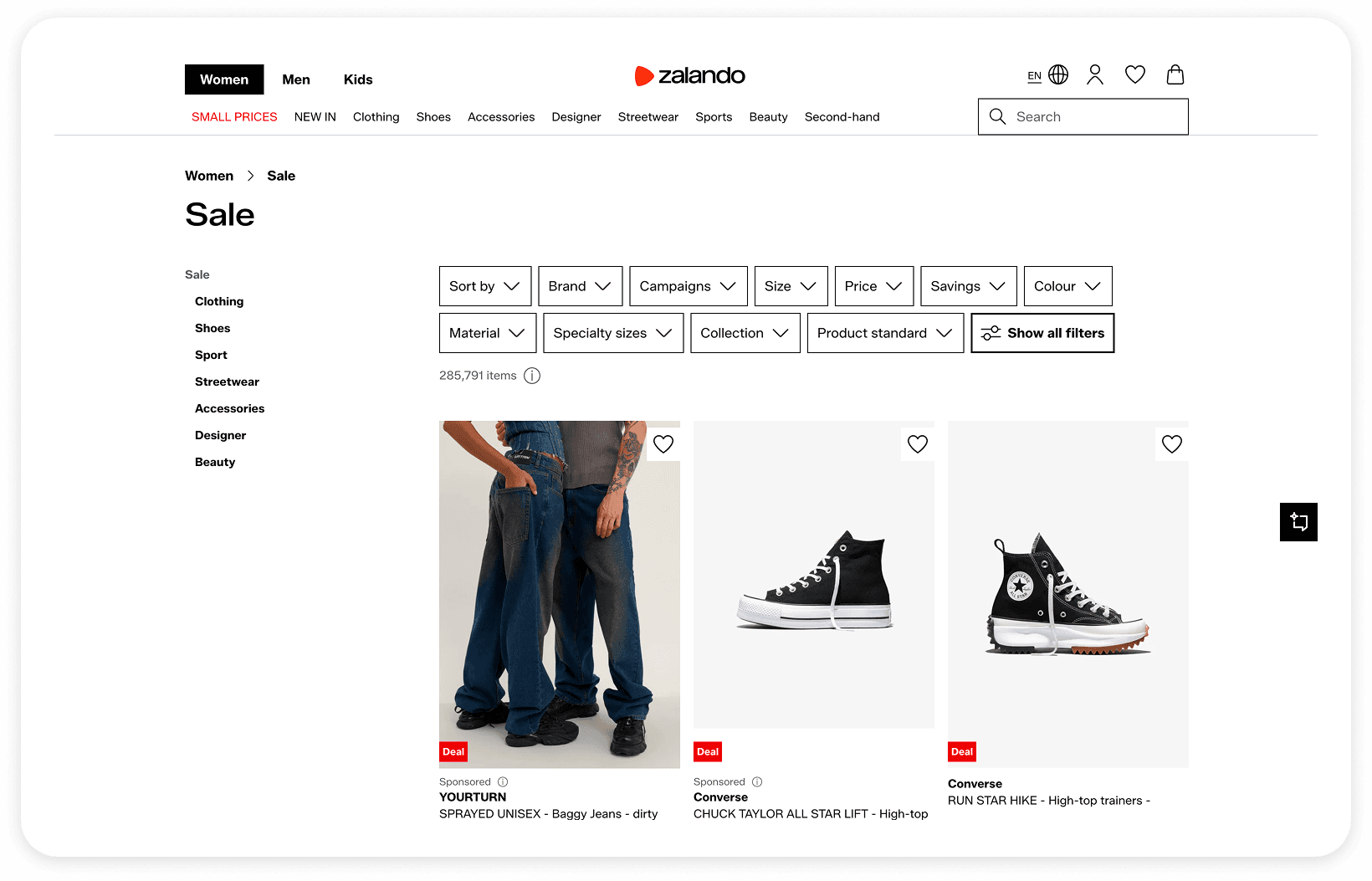
It’s worth noting again however that larger discounts don’t automatically improve ranking. The first product in the above screenshot has a discount of only 10% so other factors (eg. brand equity) have driven it to the top rank.
- Fair Pricing and Median Price Compliance
Zalando compares listing prices across sellers and channels. If your price deviates too far from the median, your product may suffer reduced visibility. It’s recommended that you:
- Stay within typical category price ranges.
- Avoid extreme discounting (more than 30% below median), which can be seen as unsustainable or indicative of quality issues.
- Avoid extreme premiums (more than 20% above median), or you’ll lose out to lower-priced competitors.
Best-in-Class Pricing Examples on Zalando
Here are two examples of pricing strategies that generally work well on Zalando:
- Nike Sneakers in High Price Bracket
Product: Nike AirMax 270
Scenario:
The launch price was €159. Many sellers priced at €159–€165, with scheduled promotional price of €139 during sale periods.
Why it worked:
- The price stayed within a competitive range
- Scheduled promotions matched market expectations
- It had frequent visibility in Sale and New Arrivals categories
Result:
Consistently high search ranking for “Sneakers €120–€150,” driving Page 1 impressions throughout seasonal promotions.
- Zalando Own Brand Basics
Product: Zalando Essentials Sweatshirt
Scenario:
The starting price was €39,99 with occasional promotional pricing at €29,99 and inclusion in flash sales.
Why it worked:
- It fitted well in high-traffic mid-range price bracket (€30–€50)
- Zalando algorithmically boosted it, using internal incentives
Result:
Strong visibility in both Men’s Tops and Sale searches.
Pricing Strategy Failures
These are approaches which you should not apply for Zalando (or other marketplaces).
- Extreme Low Pricing
Scenario: A seller dramatically underprices a brand SKU (e.g., €79 vs market median €99) to “win the buy box.”
Consequence:
- Short-term sales spike
- Algorithm flags the seller, reducing their ranking because it appears too cheap to be credible or sustainable
- Other sellers may reduce prices, hurting the product’s category health
Result:
Temporary visibility gains and increased net sales but margin loss and long-term ranking drop.
- High Price Without Value Signals
High pricing without brand equity or obvious value often fares poorly. An unknown brand priced near established labels with little or no competitive values will see low clicks and conversion. The lack of engagement translates into lower ranking. Even high-quality products can get lost behind lower-priced but known brands with higher engagement.
- Static Pricing in a Dynamic Market
Fashion demand is highly seasonal and trend-driven. Failure to adjust pricing according to trends and competitor changes leads to:
- Poor conversion rates
- Reduced dwell times
- Declines in Search ranking
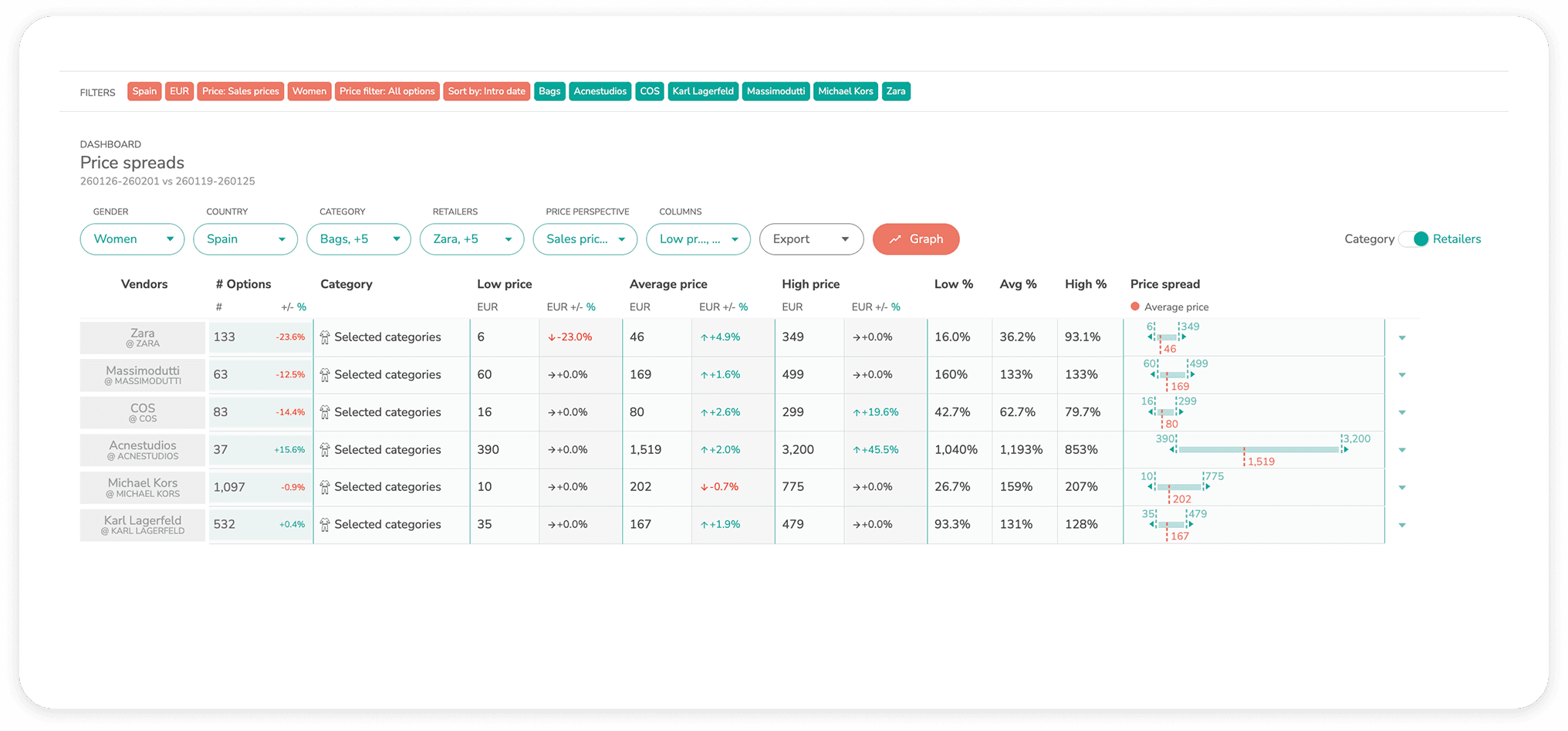
Successful sellers use dynamic pricing tools, including competitor price monitoring like Norna, to adjust prices based on demand trends, competitor pricing, seasonality, and Zalando sales cycles.
Optimising Your Pricing Strategy on Zalando
Here’s a practical checklist to help achieve Page 1 visibility:
- Understand your Category’s Pricing Bands: Look at where most products are clustered and position your prices accordingly. Make sure that your pricing architecture is balanced and consider using Value-Based Pricing methodology to ensure optimum initial pricing for your products.
- Use Scheduled Promotional Prices: Feed both regular and promotional prices with start and end dates, so your product automatically qualifies for sales and markdown filters.
- Avoid Extreme Pricing: Stay near category median to maintain credibility with the Zalando algorithm.
- Consider Strategic Markdowns: Short-term markdowns can significantly boost impressions and conversions, leading to better long-term ranking signals.
- Monitor Competitor Moves:Use price-tracking tools like Norna to constantly observe the competition and adjust in real time.
- Coordinate with Seasonal Campaigns: Align pricing with seasonal events (Back-to-School, Black Friday, Christmas) for maximum visibility spikes.
Summary
The right pricing strategy on Zalando is not about being the cheapest or the most expensive — it’s about aligning prices with category expectations, competitor behaviour, and customer psychology while taking advantage of promotional and markdown mechanics that elevate visibility. Obviously, your pricing strategy should also reflect your brand equity, and the methodology should be adjusted accordingly.
A strategically priced product that hits psychological price points, uses scheduled promotions, and participates in sale events stands a much stronger chance of appearing on Page 1 search results, driving impressions, clicks, and ultimately, sales.
Price Monitoring Support
Please contact us at Norna directly to arrange a free demo of the analytics tool and let us show you how we can enhance your pricing decisions. We’re also happy to discuss your specific monitoring requirements.
The information and opinions expressed in this article are those of the author and do not necessarily reflect those of Norna.