How Norna Wholesale Tracker gives global brands the pricing intelligence they’re missing, without crossing the regulatory line.
You’ve done the work. You’ve set your RRP with care, factoring in cost base, market differentials, currency effects, and brand positioning. You’ve built a pricing architecture that reflects where your products should sit in the market.
Then your products move into the hands of retail partners. And the architecture meets reality.
A retailer discounts earlier than expected. A marketplace listing slips below the price floor. A promotion in one market creates a new consumer reference point that ripples into another. None of it requires anyone to break an agreement. It’s just how independent retail pricing works.
The challenge here is that this happens largely out of sight.
The regulated blind spot
Competition law in most major markets prohibits resale price maintenance, directly or indirectly requiring a retailer to sell at a specific price. Your RRP is a recommendation, not a rule. Retailers price independently, and that independence is legally protected.
This creates what might be the most uncomfortable structural reality in wholesale management: you are commercially accountable for pricing performance, but legally constrained from controlling the pricing decisions that drive it.
The practical response for many brands has been to default to limited visibility. Periodic spot-checks. Account manager feedback. Occasional manual reviews of key retail partners. It’s a reasonable workaround when your retail footprint is small. It breaks down at scale.
When you’re operating across multiple markets, dozens of retail partners, and product ranges spanning hundreds of SKUs, manual monitoring doesn’t give you a picture of the market. It gives you snapshots, and snapshots miss the patterns that matter.
Price erosion doesn’t typically arrive as a single dramatic event. It accumulates: one retailer discounts and doesn’t return to full price, another adjusts in response to a local competitor, a marketplace listing drifts down over several weeks. By the time any of this registers in sell-in negotiations or quarterly margin reviews, the pattern is already established and the corrective options are narrower.
What structured visibility actually looks like
Norna Wholesale Tracker is built specifically for this regulated reality. It provides continuous, factual visibility into how your products are priced across wholesalers, retailers, and resellers, without making pricing recommendations, issuing guidance, or engaging in any form of retailer coordination.
The distinction matters. Wholesale Tracker is an observation tool, not an enforcement tool. It tells you what is happening in the market. This way, you can make informed, data-driven decisions with full transparency into real market behavior. In practice, the platform delivers several types of intelligence that manual monitoring cannot reliably provide at scale.
SKU-level price tracking. Actual selling prices, discounts, and price changes tracked at SKU, colour, and size level, across owned sites and third-party marketplaces. Not category-level aggregates. Not brand-level summaries. The granularity that tells you which specific products are drifting, where, and by how much.
Discount and campaign signals. Detection of when products enter promotion, how aggressively they’re discounted, and for how long, including early or off-calendar activity. If a retail partner starts a promotional cycle two weeks ahead of the expected period, you see it in time to assess the impact rather than after the fact.
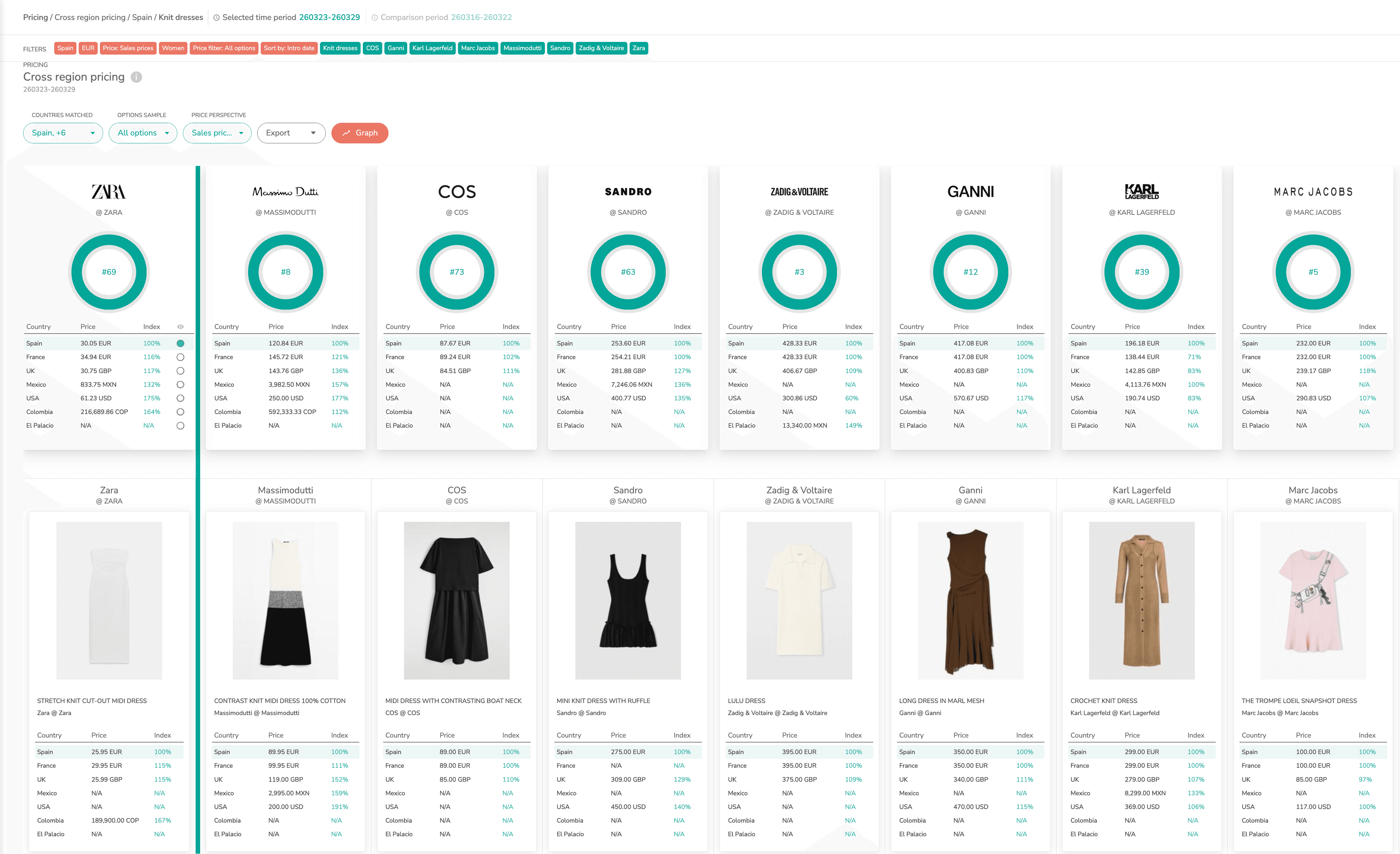
Cross-market and cross-channel comparison. Pricing behaviour compared across retailers, countries, and channels simultaneously. This is where structural patterns become visible: a retailer consistently pricing below peers in a given market, a marketplace channel operating at a different price level to the brand’s own DTC, a regional differential that’s widened beyond the expected range.
Historical price context. Price trajectories over time, enabling teams to distinguish an isolated event from a systemic issue. A single promotional discount looks very different from a retailer that has progressively repositioned your product’s price over six months.
Reseller and wholesaler mapping. Visibility into which retailers and sellers are actively offering your products, including marketplace sellers that may not be part of your direct wholesale relationships.
Where the value lands internally
The commercial case for pricing visibility tends to focus on protecting margin and brand equity, and rightly so. But the operational impact runs wider than that.
Brand and commercial alignment. Pricing drift affects brand perception as much as margin. When products are consistently available below RRP, consumer price expectations shift. And once they shift, they’re difficult to reset. Giving brand teams access to the same factual market view that commercial teams are working from means brand positioning and commercial priorities can be weighed against the same evidence, not discussed in separate rooms.
Sales team effectiveness. Fact-based commercial conversations with retail partners are both more effective and more compliant than instinct-based ones. A sales manager who can reference observed market behaviour, how a product is positioned relative to peers, how a particular retailer’s promotional activity compares to the broader market, is having a different quality of conversation than one working from anecdote or fragments.
Upstream planning. Visibility into the gap between planned pricing and market reality in a given region feeds back into RRP-setting, product allocation decisions, and the commercial terms of new wholesale relationships. This insight improves how you plan for what comes next.
Replacing anecdote with evidence
“The Global Pricing Playbook: From RRP to Market Reality” covers in depth how leading brands approach RRP-setting across currencies and markets, manage the complexity of promotional cycles and markdown strategy, and navigate the gap between planned pricing architecture and actual market behaviour.
One of the consistent threads running through that analysis is the role of data quality in pricing decisions. The brands that manage pricing most effectively at scale aren’t necessarily doing something structurally different in how they set RRP. They’re doing something different in how they monitor and respond to what happens after.
The move from fragmented manual checks to continuous structured intelligence changes the nature of the decisions available to you, because you’re working from a complete picture rather than a partial one.
In a regulated wholesale environment, you cannot control how your retail partners price. But you can have a clear, current, factual view of what they’re doing. That visibility is the lever you have. Wholesale Tracker is built to make it a lever worth using.
“The Global Pricing Playbook: From RRP to Market Reality” covers the full complexity of international pricing strategy, from RRP-setting and currency effects to markdown strategy and the role of AI-driven analytics.